

Having a more aligned smile may affect your life on a daily basis in a positive way. However, choosing the appropriate means of getting an ideal smile is not always easy. Clear aligners and metal wires can effectively realign your teeth. Choosing between Invisalign vs braces in Lowell depends on a number of factors, including cost, duration of treatment, and outcome.
Patients who are considering orthodontic options should be provided with a clinic that gives the full picture of differences without pushing one particular means. This is the kind of service offered by Dental Quest, which has been operating as a Lowell dentist since 2009 with a transparent and unbiased approach.
Invisalign vs Braces in Lowell: Choosing the Right Treatment
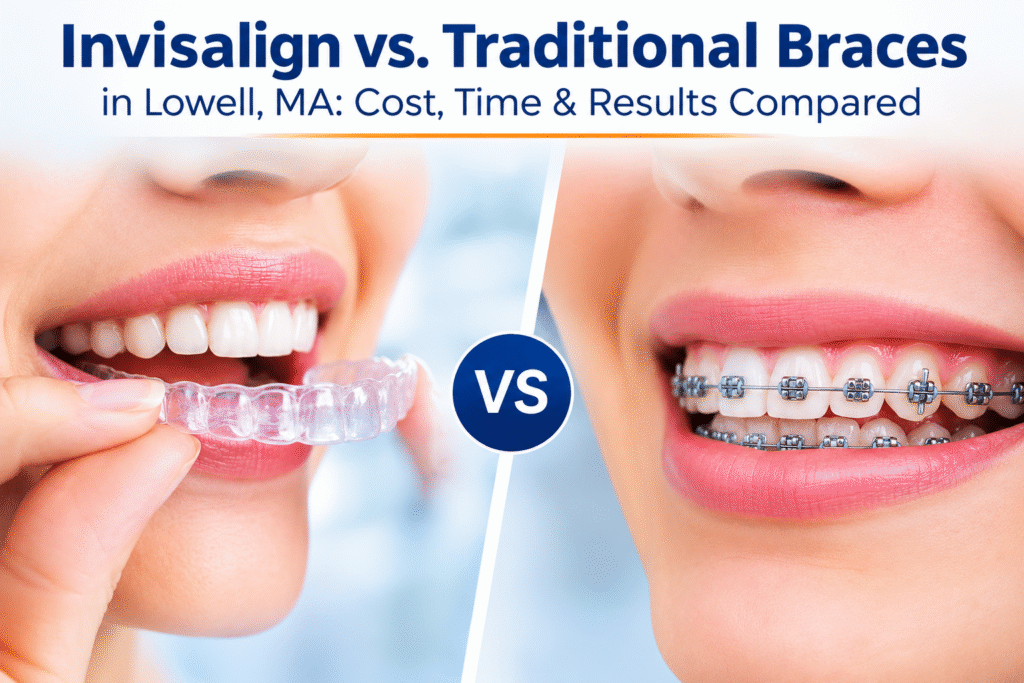
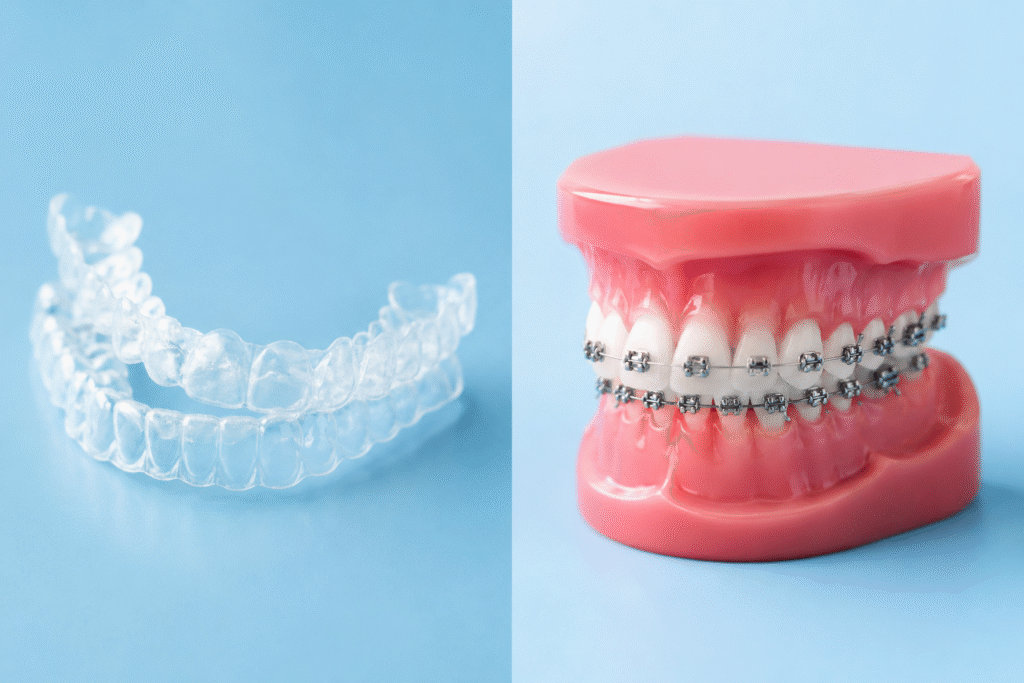
Traditional braces involve metal brackets and wires glued to individual teeth to move them with constant pressure, which will be adjusted at every appointment. Invisalign uses transparent plastic aligners that move teeth in small increments. These appliances serve equally well when used in the case of such as overcrowded and misaligned teeth, gaps between teeth, and some malocclusions, but not all cases can be treated with aligners.
The main distinction between clear aligners vs metal braces in terms of results is not obvious from the start; it appears in patients’ daily routines. The former can be removed for eating and brushing teeth, while the latter remain permanently attached to the patient’s mouth all the time. Neither of these treatments is better or worse; it all depends on individual needs and preferences.
Not Sure Which Treatment Fits Your Smile?
Cost, timeline, and comfort all depend on your unique bite. Get an honest, no-pressure comparison from Dental Quest Lowell, X-rays, options, and a clear plan, tailored to you.
Book My Orthodontic Consult MassHealth, Medicaid & major insurance acceptedInvisalign Cost Compared to Braces Cost
The main question asked by many is the cost, and the truthful answer is that the price of both options is fairly similar. The cost of metal braces in the Lowell area is usually somewhere from $3,000 up to $7,000, depending on the length of the treatment and the complexity of the correction needed. The Invisalign cost in Massachusetts usually falls within the same range, somewhere from $3,500 up to $8,000, with less costly and more costly scenarios for simpler or complicated cases, respectively.
It is not about the Invisalign vs braces cost difference but rather about what additional costs may be incurred because of the different needs of each method. For example, braces can sometimes need an emergency visit because of a poking wire or loose bracket, while aligners will save you from these kinds of repair visits but will make sure that you do not lose a tray.
How Long Does Invisalign Treatment Take Compared to Braces?
The duration of treatment is highly dependent on the severity of the issue, but there are certain trends that one should expect. A normal Invisalign treatment timeline usually takes 12 months, and the patient will be using 18 to 30 aligners during the process, changing each one after about two weeks. Simple treatments will take less time, while complicated bite alignments might last up to 18 months.
Traditional braces usually take slightly longer periods, ranging from 18 to 24 months to complete a treatment because they have a gradual effect on the alignment of your teeth. The reason is that you have to visit your dentist every four to six weeks for adjustment of your braces.
Comfort and Lifestyle Differences in Adults
Adults deciding whether to get braces usually focus on comfort rather than the technical side. Aligners will work better for individuals seeking a virtually invisible orthodontic appliance that is removable at work and other social events due to transparency and the ability to take them off. Also, the discomfort from the inner cheek rubbing against sharp metal ends or brackets will not be an issue.
That being said, if a patient finds it challenging to adhere to instructions concerning wearing the aligners, adult braces in Lowell are another decent alternative as they do not need to be removed, thus eliminating any chances of not putting them back. In addition, braces can deal with more complicated bite problems without additional brackets. Comfort is more about the patients’ lifestyle than anything else.
What Approach Produces More Reliable Long-Term Outcomes?
In both cases, a good result can be achieved if the correct diagnosis is made, and the patient is able to maintain wear or attend appointments regularly. Invisible aligners work extremely well with mild to moderate crowding, spacing, and slight bite correction, and today’s aligners are capable of correcting more cases than the previous ones. If we talk about more complicated rotations, deep overbites, or the need to make precise vertical movement, braces are more reliable in those cases.
The long-term outcome also largely depends on how strictly a patient uses retainers after the end of orthodontic correction, whatever method was used. Not using retainers is the main reason why patients’ teeth move back to the initial position rather than a flaw in the chosen treatment. If a dentist is capable of analyzing your bite and habits, X-rays, and other information, they will guarantee you a stable result.
Your First Visit to an Orthodontist in Lowell
For most people, the first visit is shrouded in uncertainty as to what is actually going to take place, but preparation is key. Usually, a first consultation will include an examination, digital X-rays, and discussion regarding your aims, be it the correction of crowding, closing of a gap, or the correction of a problematic bite. After this, your dentist will discuss with you which treatment options would really suit you, instead of recommending something easier to market to you.
Take your list of questions with you to your first visit, because this is your best chance to compare timelines, expenses, and practicalities all at once. Ask your orthodontist about any payment plan, how many visits you are expected to make, and what will happen should your case prove to be more complicated than initially assumed.
Taking Care of Your Smile While Undergoing Orthodontic Treatment
Taking care of your mouth is crucial when you have braces because there are many additional spaces where bacteria can accumulate. You need to brush your teeth after every meal and floss them with special tools to get all food particles out of those little spaces between brackets and wires. If you don’t do this for at least a week or two, you may end up with unsightly white spots on your enamel once you take off the appliance.
People who use invisible aligners should be careful because wearing trays of aligners over unclean teeth for several hours a day can lead to bacteria getting trapped between aligners and your enamel and causing cavities or infections in your gums. You can prevent this by rinsing the trays regularly and brushing your teeth before putting them back.
Finding a Provider You Can Trust With Your Smile
Innovation of braces or aligners is less important than the ability of the person treating you to make an accurate assessment, because the most technologically advanced system still needs an accurate diagnosis to create a good outcome. A good orthodontist will be able to describe the pros and cons of different options and not try to sell you the most expensive solution.
People interested in Invisalign in Lowell, MA know that being open about communication becomes quite important, because orthodontic treatment takes up to a year to complete. Orthodontist that answers questions, explains delays, and is ready to modify the treatment plan when necessary will make the entire experience quite easy. Taking some time to find such a doctor before treatment is usually very useful.
Choosing the Right Option for Your Smile
Evaluating cost, time, and lifestyle in the same context is the wisest move in choosing between Invisalign vs braces in Lowell, and there is no one-size-fits-all solution. Whatever may suit an adult professional may not suit a teen and vice versa. It all depends on your unique situation, but a good start will be to speak to your dentist for an honest opinion based on the examination of your teeth and a clear estimate of time and cost that is tailored specifically for you.
At Dental Quest Lowell, we have been helping patients make informed decisions regarding such treatments. We have helped many people make up their minds with a no-nonsense approach, while at the same time accepting patients covered under MassHealth, Medicaid, and major insurance companies.
If you are considering Invisalign in Lowell, then schedule a visit with us to get an unbiased opinion about it.
FAQs:
Q.1 Can Invisalign successfully correct an overbite like traditional braces?
Invisalign works great on a mild to moderate overbite; however, for a severe overbite, traditional braces or extra attachments might be needed to get the same precision due to the new design of aligners that allow vertical teeth movement. The dentist will be able to recommend the right solution after examining your X-rays.
Q.2 Is there any difference in coverage of Invisalign versus braces by my insurance?
The coverage provided by most dental insurance plans that have benefits for orthodontics covers Invisalign as much as traditional braces because both types of correction are considered orthodontic treatment.
Q.3 How many hours a day should I wear aligners?
To ensure timely treatment with Invisalign trays, you need to wear them about 20 to 22 hours per day, meaning that you may remove them only to eat, brush, and floss your teeth. Inadequate wear of the trays is the most frequent cause of prolonged Invisalign treatment.
Q.4 Are there food restrictions while undergoing treatment with traditional braces?
There are indeed some restrictions related to braces in terms of the type of food you should avoid because there is a risk that such foods could damage brackets and wires. Examples of such foods include popcorn, hard candy, or even apples, as they require chewing. The good thing about aligners is that they can be removed before any meals.
Q.5 What will happen if I discontinue the use of my retainer following treatment?
Teeth will return to their initial place due to the lack of a retainer, no matter whether it was braces or aligners that corrected them. Such a process might occur a few months after discontinuation, and it might partially ruin the result achieved from the procedure.